
A diet of three meals every day plus snacks is very ingrained in our culture. Changing this eating pattern, however, could provide multiple benefits—including lengthening lifespan and healthspan.
Intermittent fasting (IF)—the practice of alternating periods of eating and fasting—has emerged as an effective therapeutic strategy for improving multiple cardiometabolic endpoints, ranging from insulin sensitivity and fat accumulation to hard endpoints such as stroke and diabetes incidence. IF can reduce body weight or body fat, improve insulin sensitivity, reduce glucose and insulin levels, lower blood pressure, improve lipid profiles, lower heart rate, increase endurance, reduce inflammation and lower oxidative stress. Intermittent fasting affects general health indicators and slows or reverses aging and disease processes. Studies have shown that intermittent fasting has broad-spectrum benefits for many health conditions, such as obesity, diabetes, cardiovascular disease, cancers, and neurologic disorders.
IF makes intuitive sense. The food we eat is broken down by enzymes in our gut and eventually ends up as molecules in our bloodstream. Carbohydrates, particularly sugars and refined grains (think white flours and rice), are quickly broken down into sugar, which our cells use for energy. If our cells don’t use it all, we store it in our fat cells. But sugar can only enter our cells with insulin, a hormone made in the pancreas. Insulin brings sugar into the fat cells and keeps it there. Between meals, as long as we don’t snack, our insulin levels will go down and our fat cells can then release their stored sugar, to be used as energy. We lose weight if we let our insulin levels go down. The entire idea of IF is to allow the insulin levels to go down far enough and for long enough that we burn off our fat.
Glucose and fatty acids are the main sources of energy for cells. After meals, glucose is used for energy, and fat is stored in adipose tissue as triglycerides. During periods of fasting, triglycerides are broken down to fatty acids and glycerol, which are used for energy. The liver converts fatty acids to ketone bodies, which provide a major source of energy for many tissues, especially the brain, during fasting. In the fed state, blood levels of ketone bodies are low, and in humans, they rise within 8 to 12 hours after the onset of fasting.
Ketone bodies are not just fuel used during periods of fasting; they are potent signaling molecules with major effects on cell and organ functions. Ketone bodies regulate the expression and activity of many proteins and molecules that are known to influence health and aging. By influencing these major cellular pathways, ketone bodies produced during fasting have profound effects on systemic metabolism. Moreover, ketone bodies stimulate expression of the gene for brain-derived neurotrophic factor, with implications for brain health and psychiatric and neurodegenerative disorders.
We have evolved to be in sync with the day/night cycle, i.e., a circadian rhythm. Our metabolism has adapted to daytime food and nighttime sleep. Nighttime eating is well associated with a higher risk of obesity, as well as diabetes. In contrast to people today, our human ancestors did not consume three regularly spaced, large meals, plus snacks, every day, nor did they live a sedentary life. They naturally practiced a form of intermittent fasting.
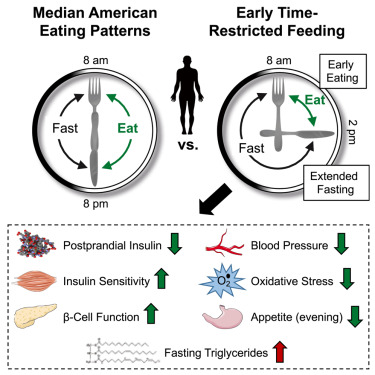
One form of IF is called time-restricted feeding (TRF). TRF extends the daily fasting period between dinner and breakfast the following morning, and it can be practiced either with or without reducing calorie intake and losing weight. Since the average American eats over a 12-hr period, TRF is defined as a limiting daily food intake to a period of 10 hours or less, followed by a daily fast of at least 14 hr.
Based on this, one study compared time-restricted feeding—where all meals were fit into an early eight-hour period of the day (7 am to 3 pm)—to normal eating spread out over 12 hours (between 7 am and 7 pm). Both groups maintained their weight (did not gain or lose) but after five weeks, the eight-hours group had dramatically lower insulin levels and significantly improved insulin sensitivity, as well as significantly lower blood pressure. The eight-hours group also had significantly decreased appetite, which could help curb food intake in the evening and, in turn, facilitate weight loss.
But why does simply changing the timing of our meals to allow for fasting make a difference in our body? An in-depth report of the science of IF states that fasting is evolutionarily embedded within our physiology, triggering several essential cellular functions. Flipping the switch from a fed to fasting state does more than help us burn calories and lose weight. The researchers combed through dozens of animal and human studies to explain how simple fasting improves metabolism, lowers blood sugar levels; lessens inflammation, which improves a range of health issues from arthritic pain to asthma; and even helps clear out toxins and damaged cells, which lowers risk for cancer and enhances brain function.
At first, in switching to an intermittent-fasting regimen, many people will experience hunger, irritability, and a reduced ability to concentrate during periods of food restriction. However, these initial side effects usually disappear within two weeks to a month.
So are you ready to give it a try? Today I started with a ten-hour eating window (8am-6pm), which I plan to keep up for a week. If all goes well, I will reduce to an 8-hour window (10am-6pm) for one additional week. Then I will move to a 6-hour window (12pm-6pm) indefinitely. For the record, I am starting at a weight of 172 pounds, and I hope to see positive results within about a month. I will let you know how it goes.
Leave a Reply