
Some animals, like tortoises and lobsters, never grow old, and learning their secrets could let humans live as long as they want. For most animals, there are three basic ways they can die: disease, injury, or old age, which is also called senescence. But a select few species are seemingly immune from aging itself, a phenomenon known as “negligible senescence”. A new study found clear evidence that negligible senescence occurs in nature.
The notion of figuring out how negligible senescence works and applying its secrets to humans is at the forefront of current life extension research. So could artificially recreating negligible senescence be the key to human immortality?
It sounds dramatic to say that certain species don’t age at all, but basically their likelihood of dying does not change with age. Negligible aging means that if an animal’s chance of dying in a year is 1% at age 10, if it is alive at 100 years, its chance of dying is still 1%. By contrast, in adult females in the U.S., the risk of dying in a year is about 1 in 2,500 at age 10, and 1 in 24 at age 80. When a species exhibits negligible senescence, aging just doesn’t happen.
In theory, if mortality rates did not increase as usual during aging, humans would live hundreds of years. If there was a steady mortality rate of 0.05% per yr—as found at age 15 in humans in developed countries—the median lifespan would be about 1,200 years. With only 1 in every 2,000 people dying every year, then the average person could expect to live for at least a dozen centuries.
As for where negligible senescence comes from—we simply don’t know the answer to that yet. If we can understand what allows some animals to age more slowly, we can better understand aging in humans. Understanding the comparative landscape of aging across animals can reveal flexible traits that may prove worthy targets for biomedical study related to human aging.
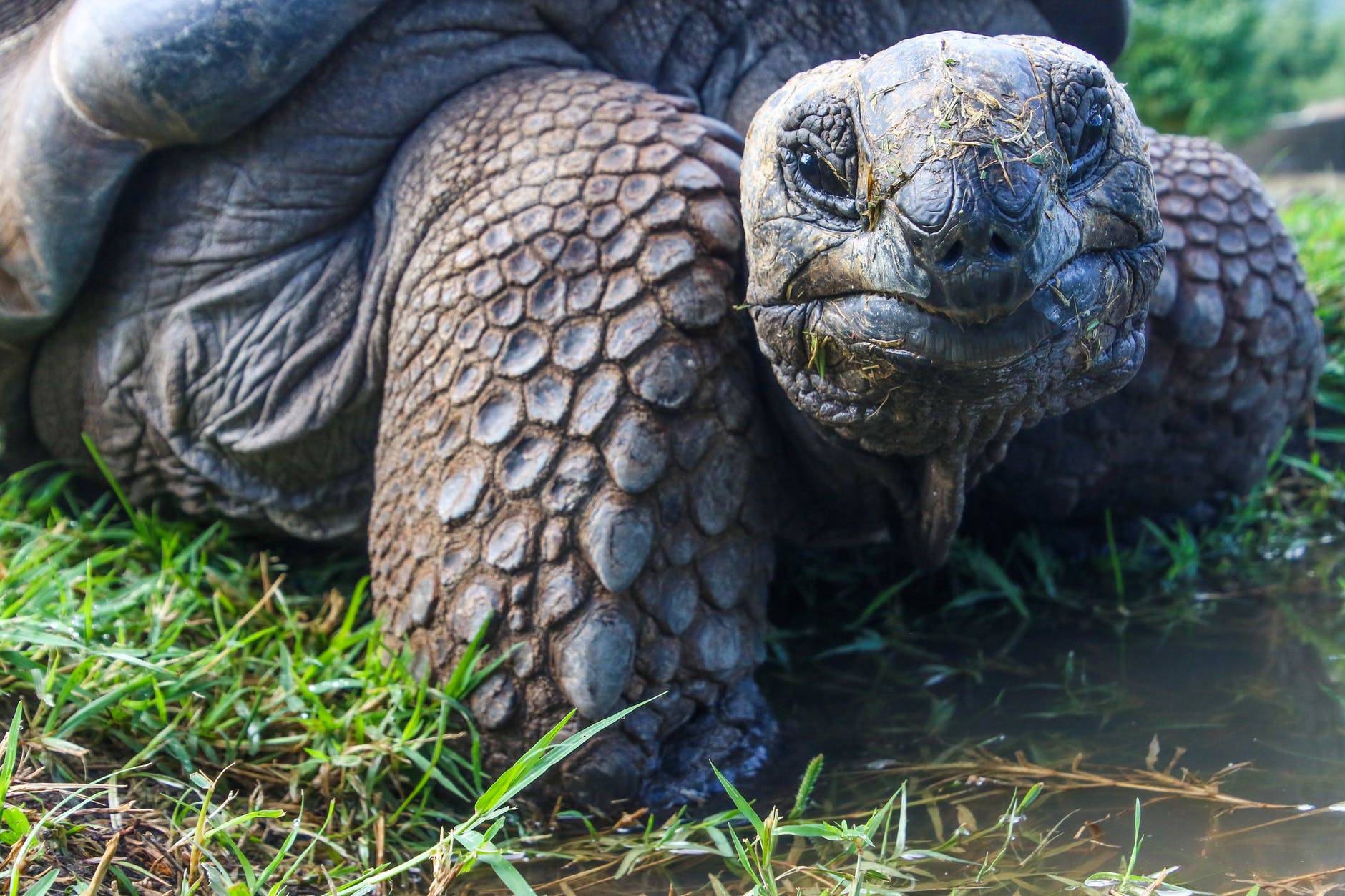
It isn’t unusual for giant land tortoises to live up to 150 years. At 190 years old, Jonathan the Seychelles giant tortoise recently made news for being the “oldest living land animal in the world.” Hard shells provide protection and have contributed to the evolution of their life histories, including negligible aging. These various protective mechanisms can reduce animals’ mortality rates because they’re not getting eaten by other animals. Thus, they’re more likely to live longer, and that exerts pressure to age more slowly. The hard shells of most turtle species contribute to slower aging, and in some cases even negligible aging—or lack of biological aging.
The basic theory is that species with lots of predators (like mice) are designed to live fast, breed fast and die fast. It doesn’t make sense evolutionarily to spend resources towards longevity if you’re just going to get eaten. Species like humans, whales and turtles don’t get eaten as much, so they are designed more towards living long lives with less frequent breeding on the assumption that they won’t be eaten before they can breed enough times to replace the population.
Giant tortoises and humans share more than 90 percent of their DNA. So it’s possible that the genes for negligible aging exist in us in some form waiting to be unlocked. Will future research find the key to achieving near immortality in humans? Studying the similarities—and differences—between humans and tortoises is a good place to start. There is no law in nature that says we need to age as we grow older. Knowing that it is possible to virtually halt the aging process should give us all hope.
Leave a Reply