
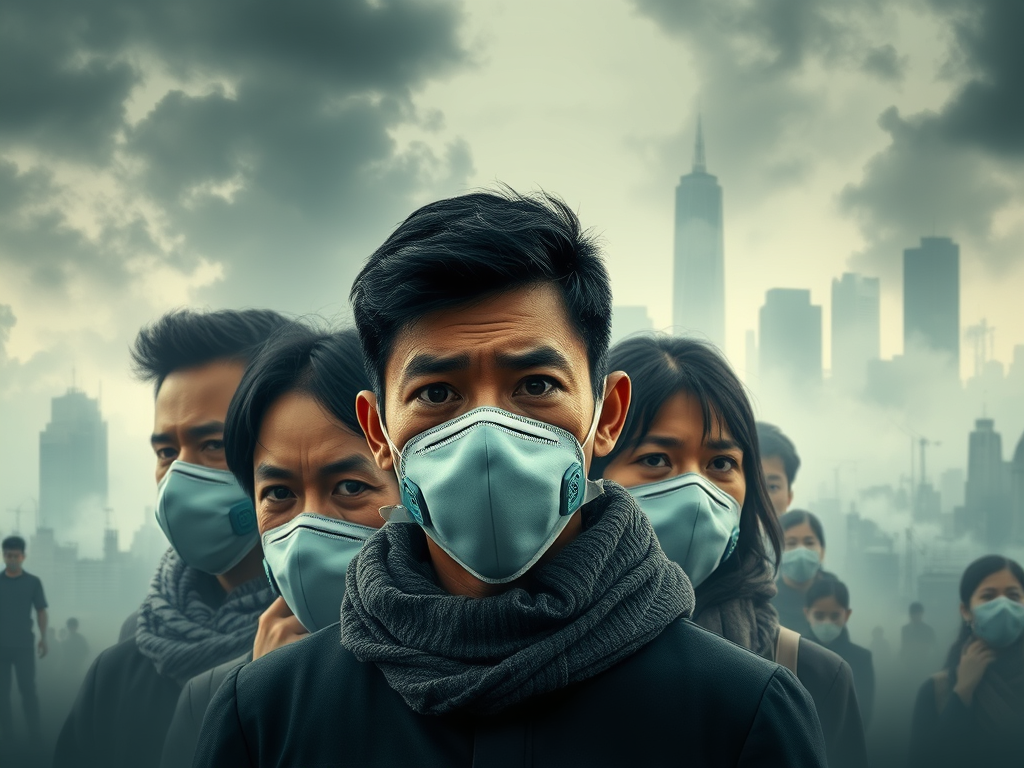
How Air Pollution Is Stealing Years From Our Lives
Nearly half of Americans are breathing dangerous levels of air pollution, cutting short their lives and compromising their health. According to the American Lung Association’s newly released 2025 “State of the Air” report, air quality is worsening across the United States, with a staggering 156 million people-46% of the population-living in areas that received a failing grade for at least one measure of air pollution1. This represents an increase of 25 million people compared to last year’s report. As climate change intensifies and environmental protections face challenges, understanding the deadly toll of air pollution has never been more urgent.
The Growing Threat of Air Pollution in America
The 2025 “State of the Air” report, which analyzed air quality data from 2021-2023, reveals a troubling picture of Americans’ exposure to harmful pollutants. Beyond the 156 million people living in areas with at least one failing grade for air pollution, 42.5 million Americans reside in communities that failed all three pollution measures tracked by the report: ozone pollution, short-term particle pollution, and year-round particle pollution1.
Particularly alarming is the disproportionate impact on communities of color. The report found that a person of color in the U.S. is more than twice as likely as a white individual to live in an area with failing grades for all three pollution measures1. Hispanic individuals face even greater inequality, being nearly three times more likely than white individuals to live in communities with three failing grades1.
Air Pollution’s Silent Assault on Longevity
Research has consistently demonstrated that exposure to air pollution significantly reduces life expectancy. A 2018 study found that fine particulate matter pollution (PM2.5) alone reduced the average global life expectancy by approximately one year3. In heavily polluted regions of Asia and Africa, the reduction was even more dramatic-between 1.2 and 1.9 years3.
The impact of air pollution on longevity rivals or exceeds many other well-known health threats. While dietary risks reduce global life expectancy by about 2.7 years and tobacco smoking by 1.8 years, the combined effect of ambient PM2.5, ozone, and household air pollution decreases life expectancy by an average of 1.65 years globally3. In South Asia, PM2.5 pollution alone reduces life expectancy by 1.6 years-exceeding the combined impact of all cancers (1.3 years)3.
Even in the United States, with relatively lower pollution levels compared to global hotspots, PM2.5 reduces life expectancy by approximately 0.38 years-significantly more than breast cancer (0.23 years)3.
Ozone: The Invisible Threat
While particulate matter often dominates discussions about air pollution, ground-level ozone-commonly known as smog-poses its own serious threats to longevity. A 2016 study found that a 5 ppb higher ozone concentration was associated with a 0.25 year reduction in life expectancy for males and 0.21 year for females5.
According to the 2025 “State of the Air” report, more than 125 million Americans (37% of the population) lived in areas with unhealthy levels of ozone pollution-an increase of 24.6 million people from the previous year’s report1. Effects of ozone exposure have been likened to a “sunburn of the lungs,” causing shortness of breath, triggering coughing and asthma attacks, and potentially shortening life1.
Global Dimensions of an Airborne Crisis
The threat extends far beyond U.S. borders. A 2021 analysis revealed that air pollution is slashing years from billions of people’s lives worldwide and represents a greater threat to life expectancy than smoking, HIV/AIDS, or war4.
India faces particularly severe challenges, with residents losing an average of 5.9 years of life due to air pollution-the highest in the world4. In northern India, where 480 million people breathe pollution levels more than 10 times higher than those anywhere else on the planet, residents could lose up to nine years of their lives4.
The top five countries with the highest average number of years lost were all in Asia: India (5.9 years), Bangladesh (5.4 years), Nepal (5 years), Pakistan (3.9 years), and Singapore (3.8 years)4.
Climate Change Exacerbating the Crisis
The 2025 “State of the Air” report highlights how climate change is intensifying air pollution challenges. Extreme heat and wildfires contributed significantly to worse air quality across the U.S.1. In the summer of 2023, smoke from Canadian wildfires severely impacted midwestern and eastern states, resulting in worse particle pollution1.
During the three years covered by the report, Americans experienced the highest number of days when particle pollution reached “unhealthy” and “very unhealthy” levels in the 26 years of reporting the “State of the Air”1.
A Call for Protection and Action
As air quality worsens, the agencies responsible for protecting public health face mounting challenges. The American Lung Association’s report calls for supporting and defending the Environmental Protection Agency (EPA), warning that “efforts to slash staff, funding and programs at EPA are leaving families even more vulnerable to harmful air pollution”1.
The stakes could not be higher. Air pollution is not merely an environmental concern but a profound public health crisis that is literally taking years off our lives. With only two cities in America-Bangor, Maine and San Juan, Puerto Rico-meeting all three clean air measures this year (down from five cities last year), the need for robust environmental protections and pollution reduction measures has never been more urgent1.
Our longevity depends on the air we breathe. As the evidence mounts regarding pollution’s devastating impact on human lifespan, addressing air quality must become a central priority for policymakers, businesses, and individuals alike.
Citations:
- https://www.lung.org/media/press-releases/state-of-the-air-2025
- https://pubs.acs.org/doi/10.1021/acs.estlett.8b00360
- https://www.cnn.com/2021/09/01/world/air-pollution-life-expectancy-climate-intl/index.html
- https://journals.lww.com/md-journal/fulltext/2016/02150/long_term_exposure_to_ozone_and_life_expectancy_in.2.aspx
- https://hsph.harvard.edu/news/groundbreaking-air-pollution-study-marks-30-years/
- https://aqli.epic.uchicago.edu/about/
- https://cleanair.camfil.us/2022/12/07/air-quality-life-index-finds-that-air-pollution-cuts-global-lifespan-by-2-years-in-2022/
- https://pmc.ncbi.nlm.nih.gov/articles/PMC3521092/
- https://science.slashdot.org/story/25/04/24/2122224/air-pollution-still-plagues-nearly-half-of-americans
- https://pmc.ncbi.nlm.nih.gov/articles/PMC6968855/
- https://www.statista.com/chart/30841/average-life-expectancy-gains-if-air-pollution-rules-met/
- https://aqli.epic.uchicago.edu/wp-content/uploads/2023/08/US-FactSheet-2023_Final.pdf
- https://aqli.epic.uchicago.edu/about/methodology/
- https://www.stateofglobalair.org/health/life-expectancy
- https://www2.purpleair.com/blogs/blog-home/update-2022-air-quality-life-index-aqli
- https://www.nature.com/articles/s41612-025-00953-w
- https://www.ourenergypolicy.org/resources/air-quality-life-index-united-states-fact-sheet/
- https://www.sciencedirect.com/science/article/pii/S016041202200277X
- https://www.tandfonline.com/doi/full/10.1080/15287394.2022.2110343
- https://www.nature.com/articles/s41370-019-0135-4
- https://hsph.harvard.edu/news/six-cities-air-pollution-study-turns-20/
- https://www.sciencedirect.com/science/article/abs/pii/S0013935122001141
- https://aqli.epic.uchicago.edu/news/polluted-air-shortens-human-lifespans-more-than-tobacco-study-finds/
- https://pmc.ncbi.nlm.nih.gov/articles/PMC6794103/
- https://pmc.ncbi.nlm.nih.gov/articles/PMC2662950/
- https://ehp.niehs.nih.gov/doi/full/10.1289/EHP3130
- https://www.nature.com/articles/s41598-024-60786-0
- https://ehp.niehs.nih.gov/0901220
- https://en.wikipedia.org/wiki/Harvard_Six_Cities_study
- https://aqli.epic.uchicago.edu/the-index/
- https://aqli.epic.uchicago.edu
- https://pmc.ncbi.nlm.nih.gov/articles/PMC3382057/
- https://www.npr.org/2025/04/23/nx-s1-5368131/air-quality-public-health-ozone
- https://www.airnow.gov/aqi/aqi-basics
- https://aqli.epic.uchicago.edu/country-spotlight/united-states/
- https://journals.lww.com/epidem/fulltext/2021/07000/a_direct_estimate_of_the_impact_of_pm2_5,_no2,_and.3.aspx
- https://www.kosu.org/energy-environment/2025-04-23/air-pollution-still-plagues-nearly-half-of-americans-that-does-a-number-on-our-health
- https://climateattribution.org/resources/air-quality-life-index-annual-update/
- https://aqli.epic.uchicago.edu/reports/
- https://pubs.acs.org/doi/10.1021/acs.estlett.8b00360
- https://www.kpbs.org/news/health/2025/04/23/air-pollution-still-plagues-nearly-half-of-americans-that-does-a-number-on-our-health
Leave a Reply