
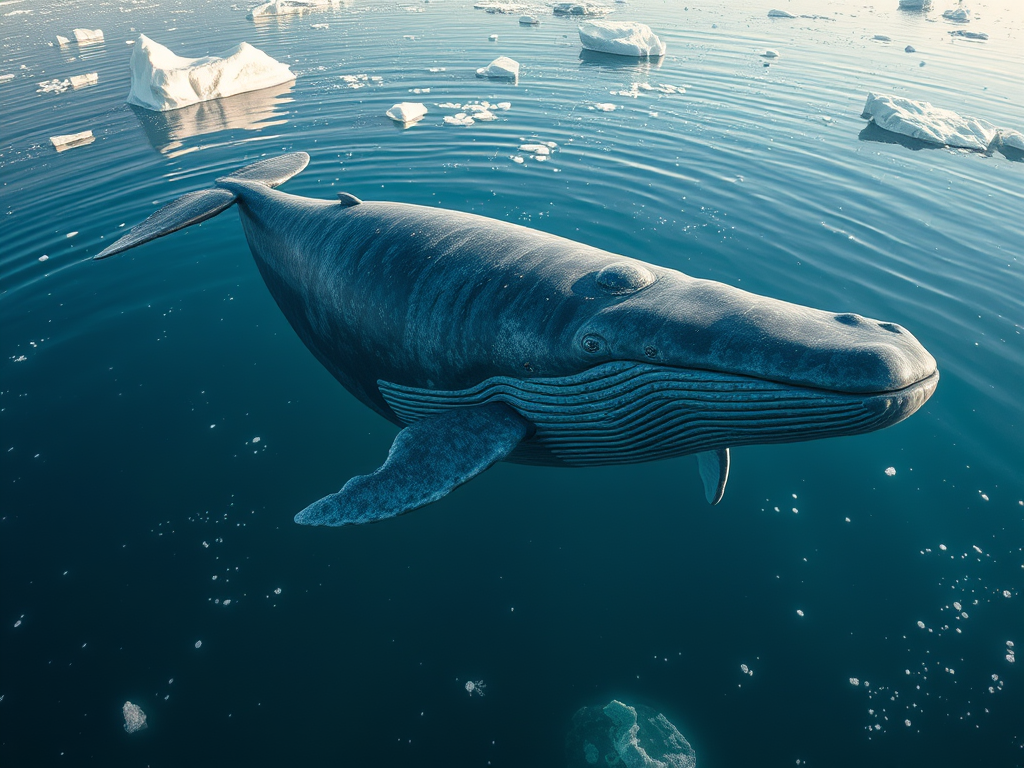
What Bowhead Whales Teach Us About Living Longer
For centuries, the bowhead whale has captivated human imagination—not just because of its massive size, weighing up to 80,000 kilograms, but because of something far more extraordinary: the ability to live for more than 200 years. This remarkable lifespan puts these Arctic cetaceans in a league of their own among mammals, but the biological mechanisms behind their exceptional longevity have remained largely mysterious until now. A groundbreaking study published recently in Nature finally reveals the genetic secret that allows bowhead whales to defy aging while avoiding the diseases that typically plague long-lived species. The answer lies in a protein called CIRBP and its remarkable ability to repair damaged DNA.
The puzzle that fascinated researchers is known as Peto’s paradox—a seemingly contradictory observation that challenges everything we think we know about cancer and aging. When we consider that larger animals have more cells and thus more opportunities for mutations to occur, we’d expect bowhead whales to develop cancer at far higher rates than humans. Yet the opposite is true. Bowhead whales, despite their enormous mass and century-spanning lifespans, show remarkable resistance to age-related diseases and cancer.¹ This paradox suggests that these whales possess unique biological mechanisms that defy the conventional rules governing cellular aging and disease development.
To investigate this mystery, an international research team led by Jan Vijg from the Albert Einstein College of Medicine, along with Vera Gorbunova and Andrei Seluanov from the University of Rochester, examined bowhead whale cells directly.² Their findings offer a profound shift in our understanding of longevity at the molecular level. When they exposed whale cells to cancer-inducing stimuli like UV radiation, they discovered something unexpected: although the whale cells were indeed susceptible to DNA damage, they displayed significantly fewer accumulated mutations than human cells. This finding pointed to a critical insight—the whales’ cells were simply better at repairing damage before it became permanent.
The researchers’ detective work led them to pinpoint the source of this exceptional DNA repair capability: a protein called CIRBP (cold-inducible RNA binding protein).² The discovery itself emerged from a fascinating side investigation into how bowhead whales adapted to their frigid Arctic environment. Scientists were studying how whale cells withstand the extreme cold of the Arctic Ocean, where bowheads are the only whale species that remain year-round.² They found that bowhead whale cells produce CIRBP at extraordinary levels—approximately 100 times higher than in other mammals, including humans.³
But CIRBP is no ordinary cold-weather adaptation protein. While it evolved to help whales survive in sub-zero temperatures by protecting against cold-induced cellular damage, it appears to serve a dual purpose with profound implications for longevity.² The research team discovered CIRBP concentrated around the whale’s DNA, where it plays a critical role in repairing double-strand breaks—one of the most dangerous forms of genetic damage.¹ These breaks, if left unrepaired, can accumulate over time and lead to cancer, cellular dysfunction, and accelerated aging.
Here’s where the research becomes genuinely exciting: when the scientists introduced the bowhead CIRBP gene into human cells, the results were striking. Human cell DNA repair rates doubled—the cells suddenly began fixing damaged DNA at significantly faster and more accurate rates than they normally would.⁴ Even more dramatically, when researchers inserted the bowhead CIRBP gene into fruit flies, the insects’ lifespans extended considerably compared to those with the typical fly gene.² This wasn’t merely an incremental improvement; it was a meaningful lifespan extension achieved through enhanced genomic maintenance.
The mechanics of this DNA repair advantage reveal why it matters so profoundly. Over an organism’s lifetime, damage to DNA accumulates relentlessly. Every day, our cells experience breaks in their genetic material from numerous sources—radiation, oxidative stress, normal metabolic processes, and environmental toxins. When these breaks aren’t repaired efficiently, they accumulate into mutations. These mutations can impair cell and tissue function, trigger cancer development, and accelerate the aging process itself.³ The bowhead whale’s abundance of CIRBP essentially creates a shield against this inevitable accumulation, maintaining genomic stability far better than most other mammals.
An intriguing experimental detail emerged during the research with particularly promising implications for human medicine: when human cells were simply cooled to 33°C—mimicking the bowhead’s core body temperature—their own endogenous CIRBP levels increased naturally, and their DNA repair efficiency improved without any genetic modification.⁵ This finding suggests that the temperature differential alone might offer a mechanistic handle for potentially enhancing human DNA repair through therapeutic interventions, whether through localized cooling, pharmaceutical triggers, or other biological approaches.
The broader significance of this research extends far beyond understanding whales. These findings provide perhaps the most concrete molecular evidence yet that genomic stability and DNA repair efficiency are among the most fundamental drivers of mammalian longevity.⁴ By studying an organism that naturally achieves what humans can only dream of—a healthy lifespan exceeding 200 years—we gain insights into the actual biological parameters that govern aging. It’s not simply about having good genes for any single protein; it’s about maintaining a finely tuned system that continuously detects and corrects genetic damage with high precision.
What does this mean for human longevity research and medicine? The immediate applications are still in early stages, but the pathway is clear. If we can enhance CIRBP expression in human cells, whether through gene therapy, pharmaceutical interventions, or adaptive mechanisms like the temperature effect, we might meaningfully improve our ability to resist cancer and slow aging. The fact that the bowhead’s adaptation evolved under the pressures of Arctic survival—solving the problem of surviving extreme cold—and coincidentally conferred extraordinary longevity suggests that nature has already solved the puzzle; we simply need to understand and translate the solution.
For those passionate about extending human healthspan and lifespan, this research marks a significant milestone. The bowhead whale has revealed that extreme longevity isn’t supernatural or inaccessible to biological science—it’s rooted in elegant, understandable molecular mechanisms centered on genomic maintenance. As follow-up research explores whether similar CIRBP enhancement might work in other organisms, including potentially humans, we’re witnessing the early stages of turning basic whale biology into practical interventions that could reshape human aging itself. In the depths of the Arctic Ocean, these ancient whales have been teaching us the ultimate lesson about longevity: the secret to living longer is essentially about living more carefully at the cellular level.
¹ Nature, Oct 29, 2025; University of Rochester press release and Tongji University analysis
² Research team led by Jan Vijg (Albert Einstein College of Medicine), Vera Gorbunova, and Andrei Seluanov (University of Rochester)
³ University of Rochester findings on CIRBP protein levels in bowhead whales
⁴ Comparative study results showing DNA repair rate increases and fruit fly lifespan extension
⁵ Experimental observation of temperature-dependent CIRBP activation in human cells
Leave a Reply